


What Is Killing My Pine Trees in Columbus GA Pine Beetles and Other Pests
A pine tree can look normal for years, then turn yellow, rusty red, or brown in a matter of weeks. In west central Georgia, that sudden change often raises one question: what is killing the pine trees?
The answer is not always pine beetles. Drought stress, lightning, root damage, soil compaction, weed killer drift, and disease can all weaken a pine. But when you see boring dust, small holes in the bark, popcorn-like pitch spots, or several pines declining near each other, the investigation should quickly turn to insects that feed under the bark.
Pine beetles are one of the most serious threats to pines in the Columbus, GA area because they do not just chew a few needles. They attack the living layer under the bark, where the tree moves water and food. Once that system is cut off, the tree often cannot recover.

Start with the type of damage you can see
Before deciding that beetles are the cause, look closely at the whole tree and the site around it. Pine problems usually fall into a few visible patterns.
Needles turning yellow, then red-brown
This is one of the most common signs of a dying pine. With bark beetles, the color change may happen after the insects have already been inside the tree for a while. A crown that turns red is often a late-stage symptom.
Small white or tan pitch tubes on the bark
Pitch tubes look like little popcorn kernels or blobs of dried sap. They form when a pine tries to push invading beetles out with resin. The color may be white, cream, reddish, or tan.
A healthy pine can sometimes “pitch out” a small number of beetles. A stressed pine often cannot.
Fine boring dust around bark cracks or at the base
This dust can look like sawdust, cinnamon, or reddish coffee grounds. It may collect in bark grooves, on spider webs, or at the root flare.
Small round exit holes
Tiny holes in the bark can mean adult beetles have already emerged and moved on. This is another sign that damage may be advanced.
Loose bark and winding tunnels underneath
If bark flakes off, you may see winding marks on the inner surface. These tunnels are made by beetles and their young as they feed and grow. The shape of the markings can help identify the insect.
Dead branches before the whole tree dies
If only branch tips or the upper crown are dying, the cause may be a different insect, drought stress, or localized damage. If the entire tree changes color quickly, bark beetles become a stronger suspect.
In Columbus and nearby west central Georgia, hot summers, dry spells, compacted soil, and storm damage can make pines more attractive to insects. Beetles often go after trees that are already stressed, but some species can spread into nearby healthy pines when numbers build.
What eats pine trees in Columbus, GA
When people ask what eats pine trees, they are usually thinking of beetles. That is a good place to start, but several insects can feed on pines in Georgia. Some damage needles. Some bore into trunks. Some attack twigs or shoots.
Here are the main suspects to know.
Pest | What it attacks | Signs you may see | How serious it can be |
Southern pine beetle | Trunk and inner bark | Pitch tubes, reddish needles, winding galleries under bark, nearby trees declining | Very serious, can spread through groups of pines |
Engraver beetles | Trunk, branches, logging debris, stressed trees | Boring dust, fading crowns, galleries that spread out from a central line | Serious on drought-stressed or damaged pines |
Black turpentine beetle | Lower trunk and base of tree | Large pitch masses near the bottom of the trunk | Often attacks stressed trees, usually lower on the trunk |
Pine sawyer beetles | Recently dead or dying pines, logs | Larger beetles, round holes, chewing in wood | Usually follows decline rather than starting it |
Pine tip moths | New shoots and branch tips | Dead shoot tips, stunted young pines | More common on young pines than large mature trees |
Pine sawflies | Needles | Groups of caterpillar-like young insects eating needles | Can strip needles but may not kill a healthy mature pine by itself |
The most urgent trunk-feeding pests are pine bark beetles. That group includes the southern pine beetle, engraver beetles, and black turpentine beetle. These beetles are small, but they can cause major damage because they feed where the tree cannot afford injury.
University tree and forest health publications commonly describe southern pine beetle as one of the most destructive pine insects in the South. The reason is simple: it can reproduce quickly in warm weather, and it can move from one pine to the next when conditions favor an outbreak.

What does a pine beetle look like, and what else looks similar
The question what does a pine beetle look like is harder than it sounds because several bark beetles look alike to the naked eye.
Most pine bark beetles are:
Very small, often only a few millimeters long
Brown, reddish-brown, or black
Hard-bodied
Cylindrical or rounded
Easy to confuse with other tiny bark insects
The southern pine beetle is small and dark. Engraver beetles are also small, but some have a scooped-out rear end with little tooth-like points around the edge. Black turpentine beetles are larger and usually attack low on the trunk.
A homeowner may not be able to separate these insects by sight alone. The damage pattern often tells more than the beetle’s body.
Pine beetle signs that matter more than the bug itself
Look for these clues:
Pitch tubes across the trunk
Southern pine beetles often attack the middle and upper trunk, though signs can appear in different areas. When many pitch tubes show up, the tree is fighting multiple attacks.
Boring dust in bark cracks
Engraver beetles often leave reddish dust in crevices. This can be easy to miss on rough bark.
Large pitch blobs near the base
Black turpentine beetles often attack the lower few feet of the trunk. Their pitch masses are usually larger than those made by smaller beetles.
Branch-by-branch fading
Engraver beetles may attack branches and upper sections, especially after drought, storm breakage, or root stress.
Several nearby trees failing
Southern pine beetle problems can expand outward. If one pine dies and nearby pines begin to fade, fast action matters.
Is there a way to know for sure
Yes, but it takes more than guessing from the driveway.
A careful inspection should include:
The color and pattern of needle decline
Pitch tube size, location, and number
Boring dust color and location
Bark condition
Tunnels under the bark
Whether nearby pines show early signs
Recent drought, grading, root cutting, lightning, or storm damage
Peeling bark from a dead section can reveal galleries, but cutting into a living tree can add stress. It is better to have the tree inspected before removing bark from any valuable pine.
A correct identification matters because the best response changes with the pest and the stage of damage. A tree that is already fully brown may not be savable. A nearby green pine may still be protected.
What are pine beetles and how they live
So, what are pine beetles? In everyday language, the term usually refers to small beetles that attack pine bark and breed under it. In Georgia, the most important ones are bark beetles that use pines as both food and nursery.
They live in and around pine forests, wooded lots, storm-damaged areas, and yards with mature pines. They do not need a remote forest to become a problem. A stressed pine in a residential lot can be enough to attract them.
Pine beetles feed mainly on pines. In the Columbus area, that can include common southern pines such as loblolly pine, slash pine, shortleaf pine, and longleaf pine. Some beetles may breed in fresh pine logs, storm-broken limbs, stumps, or trees weakened by drought and injury.
Their life cycle is one reason they are so damaging.
Adult beetles locate a suitable pine.
They bore through the bark.
They create tunnels under the bark.
Females lay eggs in those protected spaces.
The young feed and develop under the bark.
New adults emerge and fly to another host tree.
As they tunnel, they disrupt the tree’s ability to move water and food. Some bark beetles also carry staining fungi that can add to the damage inside the tree. The result is a pine that may fade from green to yellow to reddish brown.
Do pine beetles bite
The short answer to do pine beetles bite is no, not in the way mosquitoes, ticks, or fire ants bite.
Pine beetles are not looking for people or pets. They feed and reproduce in pine material. A beetle handled directly might pinch with its mouthparts, but pine beetles are not considered a biting pest for homeowners. The real danger is to pine trees, not skin.

How to prevent pine beetles, get rid of them, and stop the spread
The best time to deal with pine beetles is before the crown turns brown. Once beetles have killed the living layer under the bark, treatment cannot bring that tree back. The goal then shifts from saving that tree to protecting nearby pines.
How to prevent pine beetles
The best answer to how to prevent pine beetles is to keep pines as healthy and unstressed as possible.
Good prevention includes:
Protect roots
Avoid cutting roots, piling soil over roots, trenching near the trunk, or driving heavy equipment over the root area. Root stress can show up later as crown decline.
Water during long dry spells
Mature pines do not need constant watering, but extended drought can weaken them. Deep, slow watering during severe dry periods helps reduce stress.
Avoid trunk wounds
Mower and equipment wounds give insects and disease an easier way in. Keep a clear mulch ring around trees, but do not pile mulch against the trunk.
Remove fresh storm debris
Fresh pine limbs, broken tops, and cut logs can attract some beetles. Leaving damaged pine material near healthy trees can increase risk.
Thin crowded pine stands when needed
Where pines grow too close together, they compete for water and light. Crowded trees are often more stressed, especially during hot Georgia summers.
Watch high-risk trees
Pines hit by lightning, damaged during construction, or stressed by drought should be checked more often. Early signs are easier to manage than a spreading beetle pocket.
How to get rid of pine beetles
The answer to how to get rid of pine beetles depends on whether they are still in the tree and whether the tree is alive enough to save.
A heavily infested, fading pine often needs removal because it may hold developing beetles that can move to other pines. Timing matters. If the beetles have already left, removal may still be needed for safety, but the focus shifts to nearby trees.
Control may include:
Inspecting all nearby pines, not just the obvious dead one
Removing trees that are active beetle sources
Disposing of infested pine material properly
Protecting valuable nearby pines when they are still healthy
Reducing stress factors that helped the beetles get started
Spraying the trunk after a pine is already dying usually does not solve the problem. Beetles live under the bark, and late treatment cannot repair the tree’s damaged food and water system.
How to stop pine beetles from moving through your yard
The best plan for how to stop pine beetles is fast identification, fast removal of active source trees, and protection of at-risk pines.
This is where our tree services make the difference.
A pine beetle problem can look simple from the ground, but the decision is not simple. Is the tree still alive enough to treat? Are beetles active now? Did they already leave? Are nearby trees showing early symptoms? Is the tree a safety risk? Which pines should be protected first?
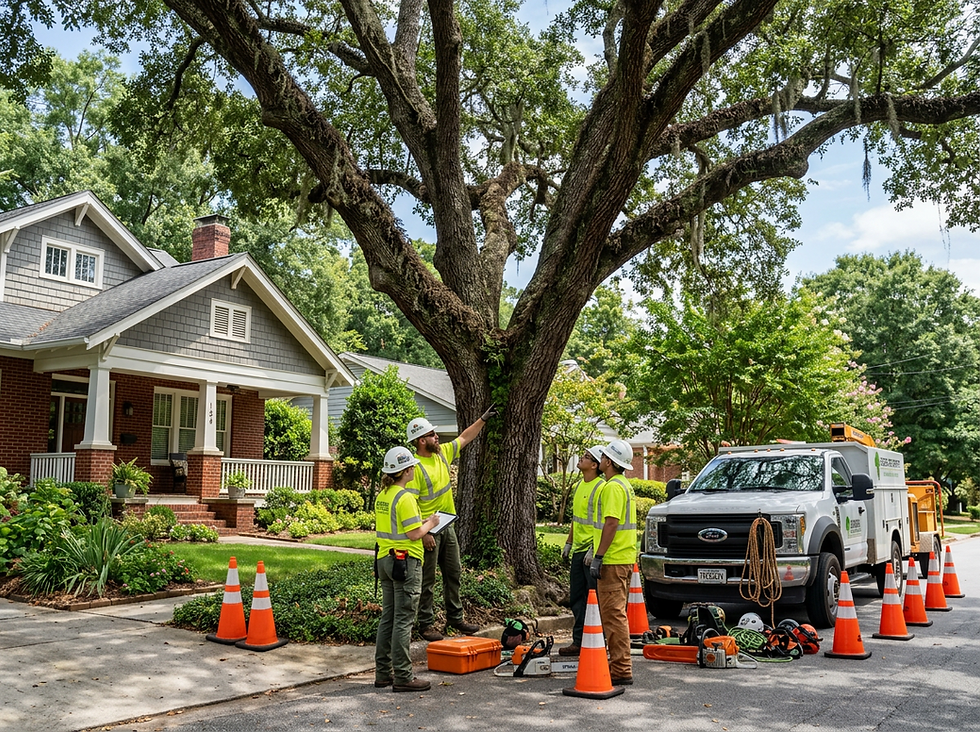
Our service is built around answering those questions on-site in the Columbus area. We inspect the damage, identify the likely pest, assess the health of nearby pines, and recommend a practical plan. If removal is needed, we can handle it safely. If prevention is the right move, we can help protect the pines that still have a chance.
That approach saves time and avoids guesswork. It also helps prevent one dead pine from becoming several.

The safest next step is a close inspection
Pine trees rarely die for no reason. In Columbus, GA, the cause may be drought stress, root injury, lightning, disease, or insects. But when the clues include pitch tubes, boring dust, small bark holes, and fast browning, pine beetles move to the top of the list.
The sooner the tree is checked, the more options remain. A brown pine may already be lost, but nearby green pines may still be protected. If a pine on your property is fading, dropping bark, or showing signs of beetle activity, schedule an inspection and get a clear plan before the problem spreads.


Comments